Standard,calculation and application of the Whiteness Index
What is the Whiteness Index?
Whiteness characterizes the degree of whiteness of a white or near-white sample, with larger values representing greater whiteness. White in the color space is in a very narrow range, can also be used in our common three-dimensional color space L * a * b * to indicate, but people are generally accustomed to using the whiteness (WI) this one-dimensional representation to measure the degree of sample white.
There are many ways to express whiteness, different industries use different methods, the use of more methods is mainly blue whiteness and CIE whiteness, in addition to Gantz whiteness, Hunter whiteness, Berger whiteness and other methods.
Many international and domestic standards will cite different methods to determine the standard, it should be noted that some standards, even if the cited method is the same, but also due to the differences in the measurement conditions and lead to different final results, there are some standards cited in more than one method. Here we give examples:
ISO Brightness
First of all, let's take a look at the blue whiteness, blue whiteness is a single-band whiteness formula that measures the diffuse reflectance factor of blue light in the short-wavelength band of 457nm, which is expressed by R457.
Most of the paper industry uses the blue light whiteness method, but because of the different standards, there are differences in the designation, such as ISO brightness, D65 brightness, TAPPI brightness, etc., the corresponding standards are as follows:
ISO2470 in the provisions of the use of integrating sphere type instrument to measure, 2470-1 for indoor daylight conditions C light source measurement to get R457, known as ISO brightness; 2470-2 for outdoor daylight conditions D65 light source measurement to get R457, known as D65 brightness.
The national standard GB/T7974 follows the ISO2470-2 standard, and added the D65 fluorescence brightness measurement method, the instrument is required to have a 420nm UV filter, UV calibration conditions obtained under the R457 and 420nm UV exclusion conditions obtained under the difference between the R457 for the D65 fluorescence brightness.
Tappi brightness there are two standards, Tappi452 requirements for 45 ° / 0 ° instrument measurement to get R457; Tappi525 requirements for integrating sphere type instrument measurement to get R457.
The national standard GB8940.1 requires that R457 be measured by a 45°/0° instrument under D65 light source conditions.
From this we can see that, although both paper whiteness, are also the use of blue light whiteness method, if the use of different standards, the results will also make a difference. Paper mills on the whiteness of the data control requirements also have their own, mainly depends on the high and low requirements of the product quality of each plant, some paper mills require their whiteness in the standard data on the basis of the up and down within the range of 1.5.
In addition, the titanium dioxide industry also use blue whiteness, some titanium dioxide companies require its blue whiteness value ≥ 92.5; standard YS/T469 in the provisions of the alumina, aluminum hydroxide integrating sphere-type instrument in the D65/10 ° under the conditions of its blue whiteness, and provides for the determination of the whiteness of the range of 70-99.9; GB2913 provides for the whiteness of plastics test method, using the blue whiteness is also used R457. R457. There are many other standards and industries that use blue light whiteness, which will not be repeated here.
CIE Whiteness
CIE whiteness is widely used in various industries, accepted by ISO, ASTM, AATCC, DIN and other associations, and is consistent with the whiteness formula from ASTM E313-95 onwards, acting under D65 light source and C light source, and is used in textile industry, construction materials, non-metallic mineral products and paper industry.ISO11475 and ISO11476 are the respective standards for paper and cardboard under outdoor light (D65/10°) and indoor light (C/2°) for CIE whiteness determination, respectively. When using CIE Whiteness, it is also important to pay attention to the required viewing angle of the light source and the type of construction of the instrument.
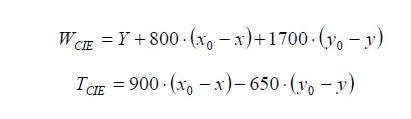
T-The lightness index
Y-value of the sample in the tri-stimulus value in the XYZ chromaticity system
x,y-x,y values of the sample in the three color coordinates in the XYZ chromaticity system
x0,y0-values of x0,y0 in the tristimulus coordinates of the fully diffuse reflector in the XYZ chromaticity system for the viewing angle of the corresponding light source
When the CIE whiteness is greater than 100, it indicates that the sample is a blue-phase white, and less than 100 it is a yellow-oriented white; when the light tone index T is greater than 0, it indicates that the sample is a greenish white, and less than 0 it is a reddish white.
Gantz Whiteness & Hunter Whiteness
Gantz whiteness is a two-dimensional formula similar to CIE whiteness. GB/T17749, GB/T23774, YS/T469 are mentioned in the formula as follows:
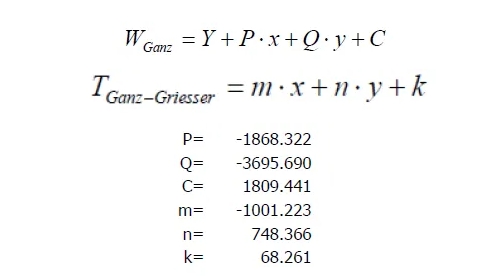
Hunter whiteness is calculated using Hunter color space coordinates.GB/T2015 white silicate cement and GB/T13835.7 rabbit hair fiber whiteness test method are adopted by Hunter whiteness, the formula is as follows:

Reference standard
ISO2470-1 "Determination of Diffuse Blue Light Reflectance Factor for Paper, Cardboard and Pulp (Indoor Daylight Conditions) (ISO Brightness)".
ISO2470-2 "Determination of Diffuse Reflectance Factor of Blue Light for Paper, Cardboard and Pulp (Outdoor Daylight Condition)(D65 Brightness)".
GB/T7974 《Determination of Blue Light Diffuse Reflection Factor D65 Brightness of Paper, Cardboard and Pulp (Diffuse/Vertical Method, Outdoor Daylight Condition)
Tappi452 "Brightness of Pulp, Paper, and Cardboard (Direct Reflection at 457nm)".
Tappi525 "Diffuse Brightness of Pulp (d/0°)
GB8940.1 《Paper and paperboard whiteness determination method 45/0 directional reflection method
YS/T469 《Aluminum oxide, aluminum hydroxide whiteness determination method
GB2913 《Test Method for Whiteness of Plastics
ISO11475 《Paper and paperboard-CIE whiteness determination, D65/10°(outdoor light)
ISO11476 《Paper and paperboard - Determination of CIE whiteness, C/2° (indoor light)
ASTM E313 "Standard Test Procedure for the Calculation of Whiteness and Yellowness Index by Instrumental Measurement of Colorimetry
GB/T17749 《Method of expressing whiteness》.
GB/T13025.2 "Determination of Whiteness of Salt Industry General Test Method".
GB/T15595 《Polyvinyl chloride resin. Thermal stability test method. Whiteness Method
GB/T23774 General Method for Determination of Whiteness of Inorganic Chemical Products
GB/T26464 Determination of Brightness (Whiteness) of Inorganic Pigments for Paper Making
GBT/5950 《Methods for Measuring Whiteness of Building Materials and Non-metallic Mineral Products
GB/T 9338 "Fluorescent Brightening Agent. Instrumental Method for the Determination of Relative Whiteness
GB/T20155 White Silicate Cement
GB/T13835.7 《Rabbit hair fiber test method. Part 7 whiteness method


How can we Help you?
Email*
Phone*
Name*
Country/Region*
Which Products are you interested in?*
Verification code
How can we Help you?
Email*
Phone*
Name*
Country/Region*
Which Products are you interested in?*
Verification code