What is a hyperspectral camera?Principles and applications in one article
What is a Hyperspectral camera?Principles and applications in one article
Hyperspectral camera, also known as hyperspectral imaging spectrometer, is a detection device that integrates spectral acquisition and target imaging, and utilizes imaging spectroscopy technology to perform spectral imaging of the same target in continuous spectral bands, completing the integration of spatial, radiometric and spectral information of the target, which greatly enhances the information dimensions of the target observation.
What kinds of hyperspectral cameras are available?
The existing hyperspectral cameras are categorized into three main types based on the principle of spectroscopy:
Dispersive
Interference type
Filter type
Dispersive Hyperspectral Camera - Grating Dispersive Type
Features: not expensive, high spectral resolution, all wavelengths can be imaged at the same time, but only one line can be imaged at the same time
Dispersive hyperspectral cameras generally utilize a dispersive element (grating or prism) for spectroscopy before being imaged on a detector by an imaging system. The following figure shows the specific principle of grating dispersive hyperspectral camera.

If we want to measure the figure of this leaf it each point of hyperspectral data, through the incident light reflected in the grating surface, the incident light at this point is broken down into different wavelengths of the energy distribution, and then through a number of sensors pixels on the specific different wavelengths of the energy to be measured. This picture shows the need for a reflective grating or transmission grating to split the light.
The advantage of this approach is that all points on a line can be processed at once. The energy at different wavelengths at each point can then be measured at once. That is why most grating-based hyperspectral cameras are designed as line-scanning cameras. The spectral data of all wavelengths of each point on a line are acquired at one time. Since the spectral data at different wavelengths of each point are acquired at the same time, the spectral data at different wavelengths of this point can be calculated at the same time. This is a very important feature of the grating type. Raster type hyperspectral cameras are particularly suitable for applications such as color measurement, classification and quality of fruits, detection of brix, and classification of plastics in plastic waste recycling, because these applications require simultaneous computation of different wavelengths at each point in order to compute the results we want.
But if we want to obtain a complete image of the hyperspectral data, not just a line of hyperspectral data, we need to make this line scanning hyperspectral camera and this leaf to produce relative movement between the leaves, as shown in the figure below, scanning over to the scanner. In this way, it is possible to obtain the hyperspectral data of a whole image of a leaf.
Now grating dispersive hyperspectral camera is the strongest spectral ability of all means, that is to say, the highest spectral resolution, the highest cost-effective, and the most widely used type of hyperspectral camera. 2020 years ago, the price of a foreign production of hyperspectral camera is still sold to 400 ~ 500,000 yuan. But now the price of hyperspectral camera produced by Hangzhou Color Spectrum has been less than 100,000 yuan in China. So it is very cost-effective. It has been widely used in color measurement, fruit classification and quality measurement, especially in sugar and acidity detection and plastic waste recycling.
Interferometric hyperspectral camera
Interferometric hyperspectral camera mainly utilizes the correspondence between the interferogram and the spectral map, with the help of interferometer to measure the interference intensity of the spectral line elements, and the inverse Fourier transform of the interferogram to obtain the spectral map of the target. The specific principle is shown in the figure
 Characterized by: expensive, high spectral resolution, a moment of the entire image can be imaged on a wavelength, not all wavelengths at the same time imaging
Interferometric hyperspectral cameras are characterized:
It is possible to get the spectral data of a whole image at a specific wavelength at the same moment.
But if you want to get the spectral data at other wavelengths, you have to move the inside of the prism after another moment to get the whole image is not at other wavelengths of the wavelength of the data.
This is a very important feature, and now there are foreign hyperspectral camera of this principle (no one has done), the price is not expensive to do. Their approach is to use a Fabry Polo cavity (FPI) as a spectroscopic device.
But this principle of hyperspectral camera, it has a very definite disadvantage in its application.
For example, if we want to make an application to pick out the desired plastic in a pile of plastics. The simplest thing to do is:
Take a hyperspectral image of the pile of plastics.
Compare each point of the spectral spectrum in the image to see which plastic he belongs to.
If you use a raster type hyperspectral camera for line scan imaging. Since the spectral data at all wavelengths are acquired simultaneously for each point in the image, the entire spectral profile of each point can be analyzed.
However, if an interferometric hyperspectral camera is used, for example, it is possible to obtain spectral data at 600 nanometers at one point in the entire image. It is necessary to move the lens (which takes some time) before the spectral image at 700 nm can be obtained. But since the 600 nm and 700 nm are not imaged at the same moment. It is possible that the light intensity and spectrum of the illuminating light source changed during the time the lens was moved. So in this case comparing the data at 600 nm and 700 nm is affected by the intensity and spectrum of the illuminating light source and is not meaningful.
Interferometric spectroscopy is still an excellent choice for applications that do not require the comparison and calculation of data at different wavelengths. But the vast majority of applications require a little bit of data at different wavelengths to be compared and calculated. This greatly limits its application.
Filter type hyperspectral camera
Since I made a filter type hyperspectral camera when I was studying, there is a lot I want to say here.
The principle of a filter-based hyperspectral camera is to put a filter in front of a normal camera, just like we wear sunglasses for our human eyes. If the filter has a narrow enough bandwidth, or spectral range, then it is possible to spectrally measure the light that is allowed to pass through.
Characteristics are: cheap, but the spectral resolution is not high, a moment can be a wavelength of the entire image imaging, not all wavelengths at the same time imaging

Although relatively high spectral resolution can now be achieved by computational imaging methods, this introduces the problem of energy linearity, which will be discussed in more detail later.
Depending on the filter, i.e. in what way do you put sunglasses on the sensor? Filter-based hyperspectral cameras can be subdivided into:
Rotary Filter Type
Wedge Filter Type
Tunable Filter Type
Quantum Dot Filter
Rotating Filter Hyperspectral Camera
The structure of the filter wheel hyperspectral camera is shown in the figure below, which takes the filter wheel as the spectral element, and obtains the spectral images of different wavelengths by rotating the filter wheel, so as to complete the spectral separation of the composite light to monochromatic light. Filter wheel is usually a set of narrow-band filters with different wavelength transmittance fixed on the wheel structure, each exposure using a filter. Control the rotation speed of the filter wheel, so that its rotation frequency and sensor sampling frequency synchronization, thus ensuring that each filter corresponding to the spectral band can be imaged on the sensor.
Advantages:
The key device of the filter wheel hyperspectral camera is the filter wheel, which can be replaced with the filter wheel of the corresponding spectral range according to the different observation bands.
The structure of the optical path is simple, and the spectral range can be replaced flexibly.
Disadvantages
However, since the switching between spectral channels needs to rely on the rotation of the wheel structure, the vibration caused by the rotating structure has a more obvious impact on the imaging quality, and the exposure time required for imaging is longer;
And a single exposure can only obtain the image of the specified spectral range, the spectral response curve is discrete, can not obtain the image of the continuous spectral band, there is a real-time problem.
At the same time, the coplanarity of each filter on the filter wheel and the thickness uniformity will also bring problems such as imaging blur.
With the development of spectral imaging technology, the number of detection bands is increasing, the filter wheel can no longer meet the high resolution observation of broad spectral bands, so it is increasingly used in multispectral detection.
::: Please note: The multispectral cameras nowadays are basically in this category!!!! :::
Examples
In 1994, the U.S. successfully launched the lunar exploration satellite Clementine, the satellite's payload: UV/VIS camera, NIR camera and HIRES camera are used in the filter wheel, covering the waveband and the relevant parameters of the filter wheel as shown in the table below. James Webb Space Telescope JWST (developed by NASA)
Filter wheels are used in the MIRI mid-wave infrared camera-spectrometer and the NIRSpec near-infrared multi-target spectrometer on board.
What is a payload?
It refers to the instruments, equipment, personnel, test organisms, and test specimens that are carried on board a spacecraft to directly fulfill a specific mission to be accomplished by the spacecraft in orbit.
NIRSpec uses a filter wheel in combination with a grating wheel, where the main purpose of the filter wheel is to break down the light wave into its different components, and then combine it with the grating wheel for more detailed spectral analysis. The figure below shows the schematic diagram of the filter wheel used by NIRSpec, which covers a spectral range of 0.6~5 um and consists of four edge filters, two band filters for different spectral bands, a transparent filter for target capture, and a reflector for on-orbit calibration. The following figure shows the schematic diagram of the filter wheel used in NIRSpec and the auxiliary structure of the filter wheel.

MIRI (one of the main payloads of JWST): MIRI mainly consists of an imager and two spectrometers, SPO and SMO, which are responsible for imaging and spectral analysis at low and medium resolution in the mid-infrared band of 5~28 uum. The filter wheel in MIRI mainly plays the role of connecting imaging and spectroscopy. As shown in the figure, the filter wheel is divided into 18 channels, including ten imaging filters, four coronal filters, one medium density filter, a double prism, a lens, and a light and dark position counterweighted with the prism. Below is a schematic of the filter wheel on the MIRI.
Euclid, one of the satellites currently under development by the European Space Agency.

Euclid is expected to launch to the second Lagrangian point, the satellite's main mission is to complete the detection of faint targets throughout the extragalactic system within five years, the payload is mainly an imaging instrument and a spectroscopic instrument, in which the spectroscopic instrument uses a filter wheel consisting of four filters for beam splitting, which is mainly responsible for the detection of the near-infrared wavelength band, in which each filter has a tilt of 8.5 ° to prevent ghost images from being formed on the detector to form a ghost image, the following figure for the spectroscopy instrument in the filter wheel of the early design model used, now what it looks like is not known.
Tunable Filter Hyperspectral Camera
Tunable Filter Hyperspectral cameras use tunable filters as spectral elements, which are mainly divided into Liquid Crystal Tunable Filter (LCTF) hyperspectral cameras and Acousto-Optic Tunable Filter (AOTF) hyperspectral cameras according to the different tuning methods. The camera is a high spectral camera.
Liquid crystal tunable filter type hyperspectral camera
Characteristics: expensive, delicate, not cost-effective
Liquid Crystal Tunable Filter Hyperspectral cameras utilize LCTF technology for spectroscopy.
What is LCTF?
In Chinese, it is Liquid Crystal Tunable Filter.
It is like an interference filter, but the wavelength of transmitted light can be controlled by an electronic signal, which can quickly and vibration-free select any wavelength in the visible or near-infrared spectrum.
LCTF is developed based on the principle of electronically controlled birefringence of liquid crystals, and consists of several sets of Lyot-type filters arranged in parallel in a cascade.
To be clear:
The diagram below shows the structure of a 1-stage Lyot filter.
When light of a certain wavelength passes through the first polarizer, it becomes linearly polarized, and when linearly polarized light enters the liquid crystal layer, birefringence occurs, resulting in unusual light (o-light) and extraordinary light (e-light), which propagate in the same direction but at different speeds, and thus the phase difference between the outgoing light after passing through the liquid crystal layer occurs.
After the second polarizer, the two beams of light interference will appear wavelength selection, that is to say, it can be decided which light can pass and which light can not.
When the temperature is certain, the transmittance function of LCTF depends only on the wavelength and voltage, and the wavelength selectivity can be realized by applying an external voltage to the liquid crystal layer using the photoelectric effect of the crystal.
Advantages:
Simple principle, small size, low energy consumption
LCTF-type hyperspectral camera mainly modulates the transmitted wavelength by voltage, which can realize fast modulation in any wide band range. Compared with filter wheel-type hyperspectral camera, it does not need wheel mechanism and avoids the influence of micro-vibration, etc., which occupies a unique position in the current lightweight and small-sized satellite payloads.
Small field of view
LCTF-type hyperspectral cameras generally have a small field of view, which is suitable for spectral imaging of designated sampling targets with a small field of view.
Disadvantages:
Low spectral transmittance, very low.
LCTF as the core spectroscopic element, its own low spectral transmittance problem, which directly limits the spectral detection ability of LCTF imaging spectrometer;
Poor temperature stability.
The refractive index of the liquid crystal is greatly affected by temperature, and the center wavelength drifts significantly with temperature changes, which will also have a certain impact on the spectral measurement accuracy.
A moment (sampling once) can only obtain the whole data of the object at a specific wavelength, want to obtain the data at other wavelengths need to be adjusted (it takes time), by the illumination source of light intensity and spectral influence, so it can not be carried out at different wavelengths of the spectral arithmetic. It is not good for use.
Examples
In 2014, Japan launched the micro-nano-satellite Rising-2, which is mainly used to observe high-resolution cumulonimbus scenes and elfin phenomena in the upper atmosphere, and the high-precision telescope (HPT) HPT on board may be the first satellite payload using LCTF technology.The HPT has a field of view of 0.28 ° × 0.21 °, and the spectral range of 400~1050 nm, where the LCTF is only used for spectroscopy in the near-infrared band (650~1,050 nm). The HPT has a field of view of 0.28°×0.21° and a spectral range of 400~1050 nm, of which LCTF is only used for spectroscopy in the near-infrared band (650~1,050 nm), and the following figure shows the optical path of the HPI on board Rising-2.
Acousto-optic tunable filter type hyperspectral camera (ATOF)
It's expensive, so the average person should back off. It's used in the military and satellites.
Principle
AOTF consists of an acousto-optic medium (usually an anisotropic crystal), a transducer array (PZT) and an acoustic terminal. Acoustic waves belong to mechanical waves, propagation in the medium will cause changes in the density of the medium, which will lead to changes in the density of the refractive index of the medium, the formation of acoustic wave wavelength for the grating constant of the transmission grating, when the light is projected to the acousto-optic medium at a specific angle will occur when the line projection phenomenon to complete the separation of the complex color light to the monochromatic light, the ATOF-type hyperspectral camera was developed according to this principle.
Advantages:
Miniaturization
Compared with LCTF hyperspectral camera, ATOF hyperspectral camera also has the advantage of miniaturization, which can be adapted to the airborne, bullet-carrying and other types of mounting environment.
Disadvantages
The wavelength tuning range of the AOTF hyperspectral camera depends on the passband of the acousto-optic product. Although the commonly used tellurium oxide (TeO,) crystals are able to cover the wavelength range of 0.2~4.5 um, the bandwidth of the ultrasonic transducer often influences the wavelength tuning range to be limited to a multiple (1x to 2x wavelengths)". Therefore, the LCTF technology is more competitive in terms of flexibility of the modulation range.
A moment (sampling once) can only get the whole data of the object at a specific wavelength, and if you want to get the data at other wavelengths, you need to adjust (it takes time), and it is affected by the light intensity and spectrum of the illumination source, so it can't be used for spectral arithmetic at different wavelengths. It is not good for use.
Example
In 2013, China launched the Chang'e-3 lunar lander on board the gazing-type hyperspectral camera VNIS also adopts the spectral principle of AOTF, the following figure shows the schematic design of AOTF.The spectral range of VNIS is 0.45~2.4 um, the field-of-view (FOV) of visible wavelengths is 60x6°, and the FOV of near-infrared wavelengths is 30x3°. The spectral range of VNIS is 0.45~2.4 um, the field of view in visible band is 60x6°, and the field of view in near-infrared band is 30x3°. VNIS uses continuously adjustable RF frequency from 40 to 180 MHz, and it realizes the spectral resolution of less than 8 nm in the band of 450~950 nm and less than 12 nm in the band of 900~2400 nm, which provides scientific exploration data for the composition of the minerals roving on the lunar surface.1 This is the first space application of this kind of technology in China. This is the first space application of this type of technology in China.

Wedge Filter Hyperspectral Camera
Wedge filter type hyperspectral camera, also known as gradient filter type hyperspectral camera, can realize continuous sampling in the spectral and spatial regions, its design concept is a wedge-shaped multilayer thin-film media as a filter, and installed in the position immediately adjacent to the two-dimensional array detector, so that a number of elements of the detector and a certain spectral band of the gradient filter correspond to each other, the following figure shows the wedge filter resonance layer thickness modulation The figure below shows the thickness modulation of the resonant layer of the wedge filter.
Gradient filter-type hyperspectral camera is mostly based on push-scan imaging, the direction of the push-scan and wavelength gradient direction is the same, through the scanning of the target can be measured to obtain the complete data, the image corresponds to all the working bands. The center wavelength of the gradient filter will also change. Due to the gradient filter different center wavelength of the corresponding film thickness changes slowly, will bring the complexity of the film structure, the number of layers and other issues, but in recent years, with the improvement of the coating process, the gradient filter spectral transmittance can reach 70%, the spectral resolution can reach 1%. According to the correspondence between the gradient filter bands and the detector image element, the gradient filter hyperspectral camera can be divided into:
Linear gradient type
Filter array type
Linear Variable Filter
Linear Variable Filter (LVF) is a special type of filter whose spectral characteristics change linearly with the position, and which can decompose the complex color light emitted by a person into spectra related to the position of the filter. LVFs are available in bandpass, highpass, lowpass, etc. The linear variable filters commonly used in imaging spectrometers are generally F-P narrow bandpass linear variable filters based on the principle of multi-optical east interference. The principle is shown below:
F-P Narrowband graduated filters usually consist of two reflective film layers with a cavity layer of graduated thickness, with the center wavelength at each position varying continuously and linearly in the direction of the gradient. It is something like the picture below.
Advantages:
Compact optical path, strong vibration resistance
Linear gradient filter and surface array detector together form a linear gradient filter type hyperspectral camera, this type of hyperspectral camera and grating type hyperspectral camera has advantages compared.
Inexpensive. Now with ion sputtering can be a large number of cheap to do.
Domestic can engage in, Changchun Institute of Optical Machinery to engage in more. Since the ion sputtering coating machine is now cheaper, so the domestic factories can also be engaged. Just ask, a lot of them can do it.
Spectral resolution (half-wave width) is also quite high up to 11nm (below), but still not as high as grating dispersion type.
High spectral transmittance, higher than grating
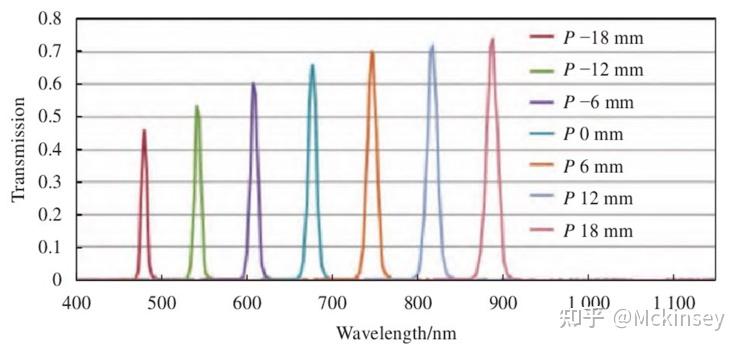
Disadvantage:
Key problem: For this kind of interferometric filter principle camera, if you want to realize accurate spectral transmittance, you have to make sure that the light is incident normal (that is, perpendicular) to the surface of the filter, and if the light is incident at a slight angle, it will lead to very large spectral errors.
Another key issue: because of the different spectral transmittance of the filter on the sensor imaging actually corresponds to different positions of the object, want to obtain a complete hyperspectral distribution of an image, in fact, and line scanning the same relative movement.
And the same point on the object, want to get the spectral data at different wavelengths, also need to move to get different spectral data.
That is, at one moment, the spectral data of all points on a line on the object at one wavelength can be obtained at the same time.
The spectral data of all points on an object at all wavelengths can only be obtained by moving the object and the camera relative to each other.
::: This paragraph is not clear enough for people to think about whether they can understand it.
This is the key issue.
It is much worse than a grating dispersive spectral camera !!!!!
This is very critical !!!!!
There is no way to do operations between different spectra of hyperspectral data in this case. The reason is stated before. :::
Example:
In 2020, the Changchun Institute of Optical Precision Machinery and Physics of the Chinese Academy of Sciences, Liu Chunyu "team to use linear gradient filter is not limited by the characteristics of the slit, combined with the digital domain TDI technology, to solve the star-carrying lightweight small high-resolution hyperspectral camera signal-to-noise ratio is insufficient, the development of a working wavelength band of 0.4 ~ 1 um, the ground resolution of 10m, the average spectral resolution of 8.9 nm, the total quality of the system is 7.9 nm. The team has developed a lightweight and small star-carried hyperspectral imaging spectrometer with an operating band of 0.4~1 um, a ground resolution of 10m, an average spectral resolution of 8.9 nm, and a total system mass of 7kg. The PI~P3 rows of the principle detector are imaged consecutively for many times, and the number of electrons imaged several times can be added to improve the image signal-to-noise ratio. In the same year, the team also announced a high-resolution, large-width hyperspectral camera using multiple gradient filter detector splicing technology, which has a width of 150 km at 500km orbit and a mass of only 9.2kg Pl. The figure below shows the schematic of the linear gradient filter and the digital domain TDI.
Filter Array Hyperspectral Camera
A filter array is a periodic structure consisting of a repeating arrangement of primitives, which can be divided into n regions, and the central wavelength passing through each region is controlled by setting the thickness of the film layer in each region, so that pixel-level spectral detection can be realized by one-to-one correspondence between the filter array and the detector image element.
::: Although each pixel corresponds to a spectrum, actually different spectra correspond to different pixels of the sensor, and the imaging corresponds to different positions of the object, that is to say, the data of each wavelength at a point in the obtained hyperspectral image are actually different points on the object that are very close to each other !!!! This is a key issue to be aware of! :::
The figure below shows a schematic of how the filter array is distributed. After data acquisition, the image elements corresponding to the same region inside different primitives are spliced together to obtain the full spectral band information corresponding to that position.

Advantages:
The filter array hyperspectral camera requires the filter array to match the detector image element when detecting, and too small a matching area will lead to a larger alignment error of the system, which will have a certain impact on the final spectral imaging quality.
Compared with the traditional push-scan hyperspectral camera, the camera acquires spectral information and image information in the way of gaze shooting (that is, one time can obtain the whole hyperspectral image, specifically means that you can get a moment to get a whole image of an object, in which each point can get all the wavelengths of the data), and can carry out video hyperspectral imaging, which has obvious advantages in the fields of dark and weak target detection, astronomical observation, airborne detection, and security surveillance. The advantages are more obvious in the field of dark and weak target detection, astronomical observation, airborne detection and security surveillance.
Disadvantages:
Requirements are not high if you can use, but not much use, this case is no way to do the operation between different spectra of hyperspectral data. There is no way to do operations between different spectra of hyperspectral data in this case, for the reasons mentioned above.
Although each pixel corresponds to a spectrum, in fact, different spectra correspond to different pixels of the sensor, and correspond to different positions of the object when imaging, that is to say, each wavelength of data on a point in the hyperspectral image is actually a different point on the object that is very close to !!!!! This is a critical issue to be aware of! Another reminder! There is no way to do operations between different spectra of hyperspectral data in this case. The reason is stated before.
Example:
Liu Chunyu and Xie Yunqiang from Changchun Institute of Optical Precision Machinery and Physics, Chinese Academy of Sciences, designed a 16-channel (4 × 4) pixel-level filter with a half-wave width of about 25 nm for short-wave infrared snapshot hyperspectral camera gates, and the filters and the whole machine used are shown in Figs. The spectral camera consists of a photographic objective, a pixel filter, a relay objective and a panchromatic detector, and the central wavelengths of the 16 channels of the filter are 1131, 1163, 1199, 1238, 1259, 1301, 1339, 1381, 1413, 1456, 1495, 1532, 1,600, 1636, 1669 nm, with 640 × 512 filter units, each of which has a half-wave width of about 25 nm. 512 filter units, each with a size of 15 um × 15 um.

Quantum Dot Filter Spectrometer
Quantum dots, also known as "nanocrystals", are inorganic materials with high self-stability and a radius smaller than the radius of the exciton borr of the bulk. Color is the intrinsic state of matter, in general, the color of the macro-materials will not change due to the change of the shape and volume of the material itself, while the quantum dots as a kind of nanomaterials of very small size, its color will change due to the increase or decrease of the number of its own atoms, i.e., to change the shape and size of the quantum dots can be tuned to the spectral range of its absorption, the use of the quantum dots of the spectrum of the tuning characteristics of the spectra to be able to achieve the function of the spectroscopy. Using the tuning property of quantum dots on the spectrum can realize the function of spectroscopy. The integration of quantum dots of different sizes on the same substrate can be regarded as a special form of filter. Individual quantum dots are extremely sensitive to transmitted light waves, reasonable control of the size, shape and arrangement of the quantum dots can be realized on the spectrum of continuous and accurate detection; the integration of different types of quantum dots together, you can realize the detection of different wavelengths at the same time, Quantum Dot Spectrometers (Colloidal Quantum Dot Spectrometers, CQDs) is developed based on the principle of the work of the quantum dots, the work of the quantum dots can be achieved. CQDs are developed based on this principle, and its working principle is shown in the figure.

Pros:
Small, cheap, exceptionally cheap, new ideas for the promotion of miniature spectrometers.
Disadvantages:
:::: However, due to the fact that quantum dots tune light waves similarly to filters, there is a serious noise problem in spectral inversion, which greatly drives the development of targeted spectral reconstruction algorithms.
Currently, the spectral resolution can be very high with the introduction of spectral reconstruction algorithms through machine learning and deep learning. However, for the most critical "energy linearity" in spectral analysis, there is a very big problem, which is why it can not be widely used for the most critical reasons.
What does it mean?
In the quantum dot spectrometer commonly used spectral reconstruction algorithms, the status quo will lead to similar "anti-convolution" operation, energy calculation accuracy is not good enough. That is to say, the actual measurement of quantum dot spectrometer can only get the spectral energy at 600nm,650nm, after applying the spectral reconstruction algorithm, the spectral energy of 600nm,610nm,620nm,630nm,640nm,650nm can be obtained, but the spectral energy obtained by the spectral reconstruction algorithm is not as good as the spectral energy calculated by the spectral reconstruction algorithm of 600nm,610nm,620nm,630nm,640nm,640nm,640nm. 630nm,610nm,620nm,640nm,650nm calculated by the spectral reconstruction algorithm, but the difference between the spectral energies of 600nm,610nm,620nm,630nm,640nm,650nm calculated by the spectral reconstruction algorithm and the real spectral energies is very large.
In NIR spectral analysis, because the signal is very weak, a 1% or 2% deviation in the energy can have a very large impact on the spectral analysis results, resulting in very poor modeling accuracy.
In the case of visible light, a deviation of 1% or 2% in energy will result in a color difference dEab greater than 1, which is unacceptable in the evaluation of color differences.
However, for the less demanding civilian field, such as cell phone photo function, this quantum dot technology applied to one of the multiple cell phone camera, you can better achieve true color shooting, restore the true color or optimize the color. It is expected that soon you can see such a program.
However, if used for spectral analysis, this technology to go a long way, I am not very optimistic. Now in the research institutions to do quite a lot of companies have Shanghai and light, Nanjing Micro-Nano, Shenzhen (I forget) :::.
Example:
In 2015, Bao Jie et al. from Tsinghua University first introduced the concept of a quantum dot spectrometer. Taking advantage of the tiny size of quantum dots, they concentrated 195 kinds of quantum dots on the same thin film and attached the film to a micro-detector array to constitute a micro quantum dot spectrometer. Theoretically, the quantum dot spectrometer can cover a spectral range of 0.2~5 um. This new type of spectrometer greatly reduces the volume and quality of the instrument while not affecting the resolution and efficiency of the spectrometer itself.
In 2021, Huiyu Li's team carried out research on quantum dot spectrometer for the near-infrared spectral band. They selected quantum dots of PbS and PbSe, and realized the spectral tuning of the two kinds of quantum dots by controlling the key parameters such as alternating synthesis, ligand exchange, and cation exchange, etc. The team used 195 quantum dots for the integration, which was used as the filter element, and selected metal oxide semiconductor as the detector, which constituted the near-infrared quantum dot spectrometer. The team used 195 quantum dots as filter elements and metal oxide semiconductors as detectors to form a near-infrared quantum dot spectrometer. Figure 24 shows the schematic diagram of the near-infrared quantum dot spectrometer developed by the team, which has a spectral range of 0.9~1.7 um, and an average spectral separation rate of up to 6 nm.

Summary:
If spectral resolution is required, grating dispersion type is the optimal choice.
If the spectral resolution requirement is low, go for a hyperspectral camera with traditional filters. But it can't do multi-wavelength operation.
I hope the technology of quantum dots can be perfected.


How can we Help you?
Email*
Phone*
Name*
Country/Region*
Which Products are you interested in?*
Verification code